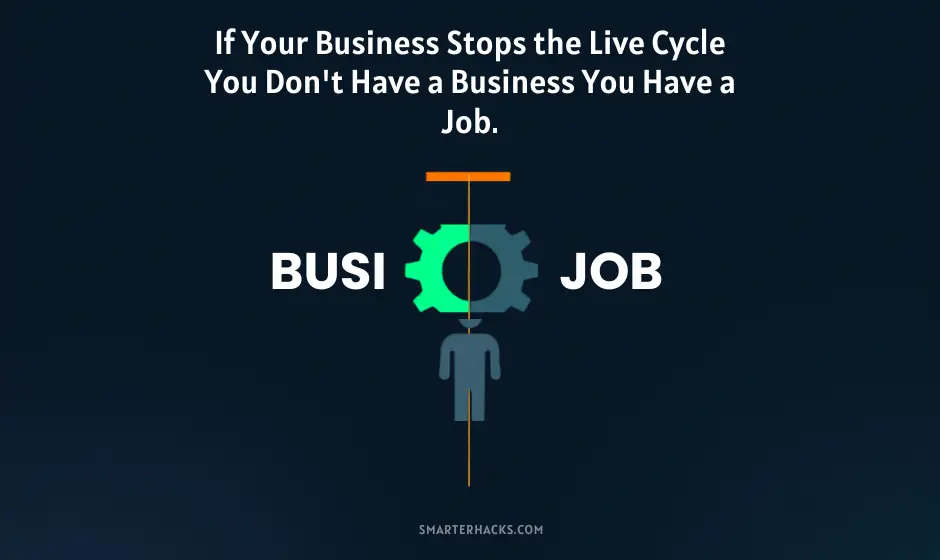
If Your Business Stops When You Stop, You Don’t Have a Business — You Have a Job

You didn’t start a business to become the bottleneck.
But somewhere between landing your first clients, figuring out your process, and trying to keep everything moving — that’s exactly what happened. Every decision comes through you. Every workflow lives in your head. Every new hire or contractor needs you to explain everything from scratch.
That’s not a business. That’s a job with more stress and less predictability.
The good news: it’s fixable. And it doesn’t require a new hire, a big budget, or a complete overhaul. It requires systems — documented, repeatable processes that run the same way whether you’re in the room or not.
Why This Happens to Every Small Business Owner
It’s not a character flaw. It’s a growth pattern.
In the early days, you are the system. You know what to do, you do it well, and moving fast means keeping it all in your head. That works until it doesn’t.
The problem is that most business owners never make the transition from operator to architect. They stay in execution mode — handling everything personally — because that’s what got them to where they are. But what got you here won’t get you there.
As you grow, the cost of everything-running-through-you compounds:
- You can’t take time off without things falling apart
- You can’t delegate because nothing is documented
- You can’t scale because every new client or project requires your direct involvement
- You can’t sell the business someday because it only works with you in it
That last one hits differently. A business that depends entirely on the founder isn’t an asset — it’s a liability.
The Real Test: Could Someone Else Run This?
Here’s a simple diagnostic. Pick one of your core processes — client onboarding, proposal creation, weekly reporting, whatever you do repeatedly. Now ask yourself:
- Is it written down anywhere?
- Could a new team member or contractor execute it without asking you 10 questions?
- Would it look and perform the same if you weren’t involved?
If the answer to any of those is no, that process is a single point of failure. Multiply that across every function in your business, and you start to see the real picture.
Most small business owners have a collection of single points of failure. The goal is to systematically eliminate them.
What a Systemized Business Actually Looks Like
A systemized business isn’t a perfect, enterprise-grade operation. It’s a business where the core processes are documented, repeatable, and don’t require the owner to be the keeper of all knowledge.
In practice, that means:
- Client onboarding runs the same way every time, from first signed contract to first delivered milestone
- Proposals follow a defined structure and can be drafted without starting from a blank page
- Weekly operations have a rhythm — reviews, check-ins, status updates — that don’t require you to schedule everything ad hoc
- When something new happens, there’s a documented process to handle it or a clear owner to make the call
None of this requires expensive software or a team of 20. I’ve helped solo operators build systems like this with a shared Google Drive, a simple project management tool, and a few well-written SOPs.
The tools matter less than the decision to document in the first place.
How to Start: The 3-System Rule
Don’t try to systemize everything at once. Start with the three processes that cause you the most pain or involve the most repetition.
For most small business owners, those are:
- Client Onboarding
How does a new client go from signed agreement to actively working with you? Every step in that sequence — the welcome email, the intake form, the kickoff call structure, the first deliverable — should be documented and templatized. This is the process that shapes the entire client relationship. It should never be improvised.
- Recurring Deliverables
Whatever you produce regularly — reports, content, strategy sessions, reviews — that process should be documented to the point where the quality is consistent regardless of your mood, your schedule, or how many other things are demanding your attention.
- Internal Weekly Review
A simple system for reviewing what’s happening in your business. What’s on track, what’s at risk, what needs a decision. This keeps you operating as the architect, not the firefighter.
Once those three are documented, you’ll have a clearer picture of where the other bottlenecks are. Build from there.
Where AI Fits Into This
Here’s where it gets practical. A lot of the documentation work that used to take hours can now be done in minutes with the right AI workflow.
Once you’ve identified a process, you can talk through it — verbally, in a voice note, in a rough draft — and use AI to turn that into a clean, formatted SOP. I do this regularly with clients. What used to take a half day of documentation work now takes 20 minutes.
AI also helps you maintain systems over time. When a process changes, you update the document. When you need to train someone, the AI can help you turn the SOP into a quick onboarding checklist or training outline.
The system still has to be built. The logic still has to come from you. But the execution — the drafting, formatting, refining — that’s where AI earns its place.
The Bottom Line
If your business runs on your presence, your memory, and your constant involvement, you don’t have leverage — you have dependency. And dependency is fragile.
Systems are what turn a job back into a business. They’re what let you grow without grinding, delegate without hovering, and eventually step back without everything stopping.
You built something worth protecting. Start treating it that way.
Ready to build systems that run without you in the middle of everything? Let’s map out where to start. Book a free discovery call and we’ll look at your biggest operational bottleneck first.