
How to Write an SOP for Your Small Business

How to Write an SOP for Your Small Business (Free Template Included)
Smarter Hacks | smarterhacks.com
If you got hit by a bus tomorrow, could someone else run your business by Friday? If the honest answer is no, you don't have a business — you have a job with extra steps and no PTO.
I've run two businesses solo, and the thing that changed everything wasn't a tool. It was writing down the ten processes I repeated every week so they stopped living only in my head.
This post gives you the exact SOP format I use, how AI cuts the writing time from an hour to under twenty minutes, and a template you can copy today.
Why "I'll Just Remember It" Is Costing You Real Money
Every task you do from memory, you do slightly differently each time. Client onboarding takes 45 minutes one week and 90 the next — not because the client is harder, but because you're improvising the steps in real time. Multiply that by every repeated task in your business, and you're paying an invisible tax in wasted hours, inconsistent client experience, and zero ability to hand anything off.
The test is simple: pick your five most repeated tasks. If you can't write the exact steps for each one right now, in order, without stopping to think — you don't have a process. You have a habit, and habits don't scale and can't be delegated.
The SOP Format That Actually Gets Used
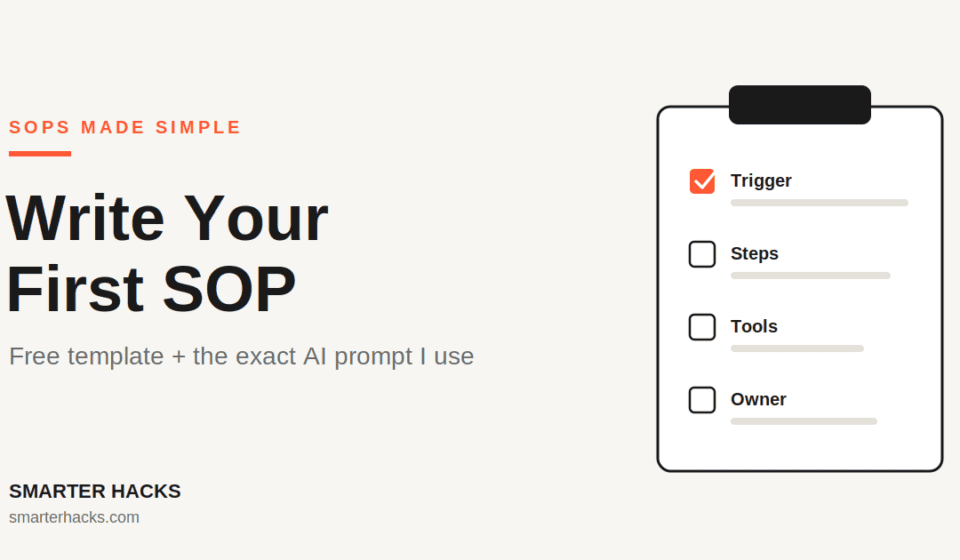
Most SOP templates fail because they're written like legal documents nobody reopens. Use this structure instead — five sections, one page, built to be read in under two minutes by someone who's never done the task:
- Trigger — What starts this process? (A new lead comes in, an invoice goes unpaid for 15 days, a client signs.)
- Steps — Numbered, one action per line. If a step has more than one decision in it, split it into two steps.
- Tools used — Name the exact app or template for each step. No "use appropriate software."
- Owner — Who runs this today, and who could run it if you're out.
- Exceptions — The two or three ways this goes sideways, and what to do when it does.
Write the SOP for the process, not the outcome. "Onboard a new client" is an outcome. "Send welcome email → create client folder in Drive → schedule kickoff call → send intake form" is a process. If you can't picture someone else doing exactly what you wrote, rewrite it.
Where AI Actually Speeds This Up
Here's the part that saves the time: you don't write the SOP from a blank page. You talk through the process out loud — or type it as a rough brain dump — and have AI structure it into the five-section format above.
The prompt I use:
This is where a tool like Claude earns its place — not because it's magic, but because turning a messy brain dump into a clean numbered sequence is exactly the kind of structuring work AI is reliable at. You still own the process. AI just removes the blank-page problem and the formatting time.
Where This Breaks (Say the Quiet Part)
Two failure modes, both common:
Writing the SOP once and never updating it. A process changes the first time a tool changes or a step gets skipped under pressure. An SOP nobody's touched in six months is documenting a process you no longer run. Put a 90-day review on your calendar for your top five SOPs — that's it, no elaborate system required.
Documenting the exception-heavy process first. Start with your most repeated, most standardized task — not the messiest one. Client onboarding or invoicing beats "handling a difficult client complaint" as SOP #1. Build the habit on something simple before you tackle the process with ten branches.
Write your SOP as a five-part structure — trigger, steps, tools, owner, exceptions — and let AI handle the reorganizing, not the thinking.
Best for: any repeated task taking more than 15 minutes a week. Skip building an elaborate SOP library before you've documented even one process end to end — start with your single most repeated task this week.
Not sure which processes are bleeding the most time in your business? Book a free 30-minute ops audit call — I'll help you identify your top three SOPs to write first.
Book Your Free Ops Audit CallThis post contains an affiliate link. If you purchase through it, Smarter Hacks may earn a commission at no extra cost to you. I only recommend tools I use in production.

